
Introduction
Most people planning a move spend a lot of time getting ready. They allocate budgets for new rentals, set up new utilities, and tell their contacts that their address is changing. Then, move-in day comes, and they lose control and screw everything up in the first hour.
Packers and movers are not just people who haul boxes. On move-in day, they are the ones who save you from disorganization and chaos. This guide is designed to help you understand their true value so you can avoid the pitfalls of not having movers and packers.
Why Moving Day is Always So Chaotic
Moving day is not just about the actual move. You have to set expectations for how the day is going to play out. There are lots of choices to make: how are you going to pack things? Are you going to need to take apart furniture? Do you have a way to get to the elevator? Do you have to move things in and out of the building at certain times? The list goes on and on.
This is the consequence of the chaos we find ourselves in on moving day. There is a truck ready to take all your stuff, but you have just started actively packing your boxes and making plans. That’s when movers come in to save the day.
The Role of Packers and Movers Before the Move Starts
Even before a box has been picked up, a professional team has already set the tone for how the rest of the day is going to run.
A crew will take a walk-through of the premises to determine the volume of goods to be transported, identify logistical challenges (like narrow staircases), and point out fragile and high-value goods. This helps determine how many crew members are needed, what equipment to use, and how to sequence the tasks.
If a crew does not have a preliminary assessment, they are working blindly, which can lead to delays, improper use of resources, and avoidable damage.
The lack of a pre-move assessment shows that relocation service providers are merely looking to cut costs. It indicates how they will perform when there is a deadline.
Packing, labelling, and organizing for moving day
When packing on moving day, it is important to consider how to protect and organize items, how to control the inventory, and how to make the unpacking process quick and logical.
Packers and movers use appropriate materials for each type of items. All fragile items, for example, are double layer wrapped with foam or bubble protection. Electronics are packed against static and impact. Artwork and mirror items get corner reinforcement. Heavier items go into stronger, reinforced cartons.
Libelling is also very important. Each box needs to have a destination room, noted handling instruction (if there’s a specific way to handle it), and a short description of its content. A box marked “kitchen” is useful. A box marked “kitchen – fragile glassware – this side up” is way more useful once it reaches the new property.
Poor systematic labeling will cause the entire moving day’s execution to fail when it comes to the unloading process. It will lead to wrong room placements for boxes, flipping highly fragile boxes, and the entire unpacking process will require a second relocation.
Loading and Handling: Where Expertise Matters Most
The loading phase is the most vulnerable time for damage. A determining factor for how furniture arrives is the order in which items are loaded.
Furniture loading order is a trained expertise. Crews start with loading heavy furniture, which is placed against the walls of the vehicle. This, in effect, creates a base. Items of medium weight are placed in the middle tier. The most tier is occupied by fragile items which are secured to prevent shifting. Appliances are placed upright and secured to prevent movement during transit.
This knowledge is not common. An untrained crew, or a crew that has little to no experience, is most likely to load whatever is ready without any weight logic that will most likely result in a load that shift during transit, crush lighter items, and leave the crew to handle damaged goods.
Furniture moving is coupled with equipment needs, like trolleys, furniture sliders, and moving blankets, in addition to the equipment professional movers bring along.
Transportation Coordination and Timing
The consequence with moving is that when the incorrect time is chosen to move, a lot of problems are triggered. An office can close, a building, parking permit may expire, and even elevator bookings can adjourn. The receiving property can also be unprepared for unloading.
This entire transport window is part of a professional move, and more than just the time to move, many other factors are considered: travel time, potential for building access delays, time needed to unload the vehicle, and just overall traffic conditions. Communication is key and for most of the move time, the receiving end of the move is alerted that the truck is about to pull up within moments.
For the untrained person, timing and coordination are extremely difficult, if not impossible, to pull off. Most people doing a DIY move learn about these timing issues after the conflicts have already occurred.
Unloading, Placement, and Initial Setup
Unloading is the final step of the moving process, but it is not the finish line. This is the last step of the line, and it has its own challenges.
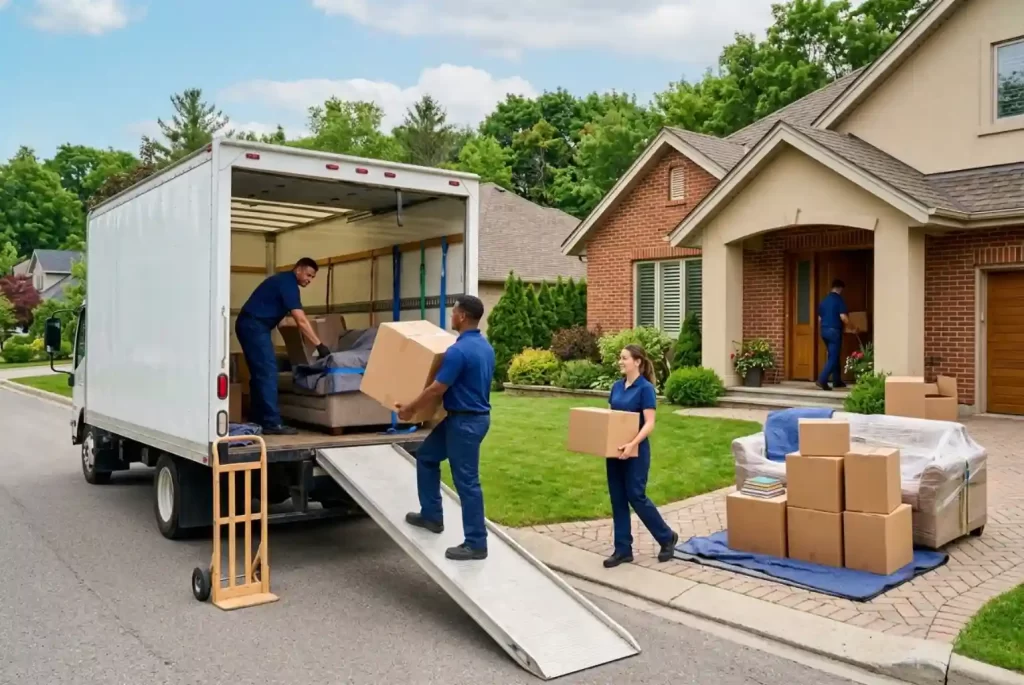
An offloading team is not just going to drop your items in a single room. They follow the label instructions to direct the items to the correct room and place heavy furniture as instructed. Large items, in particular beds, wardrobes and sofas, may be reassembled on site. Appliances may be adjusted and positioned.
The type of work described above converts a new place from a dumping ground to a functional and working environment. It also significantly decreases the physical effort required from the homeowner.
Without professionals, moving is simply difficult.
It creates new risks, which can be measured. Here are the types of patterns we commonly observe:
- Lack of sufficient packing materials. Creek sheets, newspaper, and other fabrics do virtually nothing to contain soft, hitting, and knocking impacts.
- Lack of planning a loading sequence. Irregular and random loading is likely the cause of shifting, crushing, and inaccessibility at the destination.
- Lack of acceptable time planning. It is typical of DIY crews to continue underestimating the time of a task, usually by 40 to 60 percent.
- Lack of professional assisting techniques. For the untrained, moving is likely the cause of back injuries, injuries to the foot from objects dropped, and injuries from falling during a step.
- Lack of accountability: If any damage is done to your furniture by one of your friends with a pickup truck, you don’t have insurance, you have nothing to fall back on, and you have no professional obligation to them.
These are not hypotheticals. They are the reasons people turn to moving companies after the DIY approach has failed.
How Movers Help Save Time and Reduce Risk.
The value of movers is not found within the labour they offer. It’s found within the risk they remove.
A good moving company has insurance for the items they transport. If there happens to be damage, there is a process for resolving the damage. This accountability alters the whole equation.
Time is the one thing that is saved most significantly. It may take a family with help, two days to move a 4-bedroom home. A good moving company can complete that same move in one day. This significantly reduces the window of time things can go wrong.
Professional movers bring clarity to moving day. The homeowner can concentrate on access, paperwork, and managing the move on both ends, while the capable crew does the heavy lifting.
Tips to Help Moving Day on the Day of the Move
Preparation is key for the crew, and that will be the difference as to how smooth the day flows.
Make sure that you understand the duties of the crew. Be sure to communicate any hard to access items that may require special care and be clear about what the move entails and the conditions at both places. Surprises will cost time and money so eliminate as many as you can.
Be there for both ends. Your presence as a homeowner at the starting point and destination is crucial. There are calls that only you can make.
Prepare a separate essentials box. Your box with the items of utmost importance such as documents, medication, charger, keys, and valuables should be packed and kept with you, not in the truck.
Conduct a final walkthrough before the truck pulls away. Look in every room, closet, and every cupboard, and every little bit of storage. Once the truck has left, items that were forgotten cause big problems.
Be as clear as possible with the crew lead. Direct communication between you and the team as a single point of contact eliminates baffling handoffs, contradictory orders, and needless delays.
Conclusion
This is not improvisation time during moving day. It’s a day of truth about the packing and loading decisions. The movers do not only lug boxes. They pocket the ability, speed and firm hand your relocating process needs.
The only question is not about hiring moving experts. It is about selecting the moving team with proven systems and frameworks and hands-free execution.
The most moving day choice is the one you make before the moving day, and that choice is THE MOST.

